The 3D three-point-bending notched specimen has been analyzed using direct
explicit integration. The specimen geometry is shown in Fig.
1. The constitutive model employed is based on Microplane
M4 model. The constitutive properties are summarized in table
1. In order to simulate static loading, the specimen loading has been
controlled by prescribed displacement of transverse edges on top specimen
surface "w = 0.5*0.001*(3.0-t/0.02)*(t/0.02)*(t/0.02)" (see fig.
1). The load-time history has been determined from requirement of minimal
inertia forces.
| density |
2.5 |
KN/m^3 |
| Young modulus |
60.e3 |
Mpa |
| Poisson coeff |
0.18 |
|
| k1 |
0.000095 |
|
| k2 |
160.0 |
|
| k3 |
10.0 |
|
| k4 |
150.0 |
|
Table 1: Constitutive properties
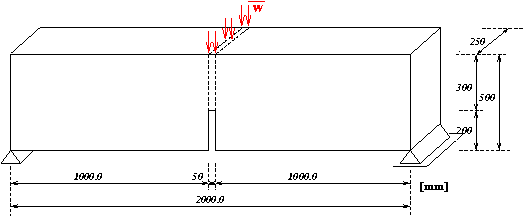
Fig 1. Specimen geometry.
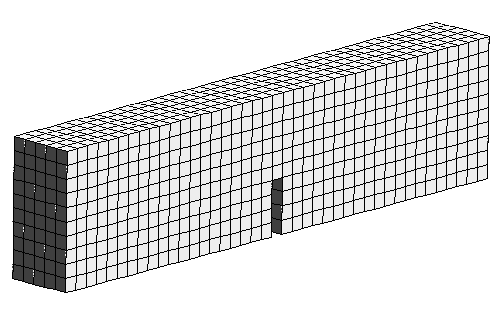
The mesh has been generated using structured grid with 2772
nodes and 2030 linear brick elements (each with 8 integration poits).
The analysis has been performed using 7500 time incremens. The next
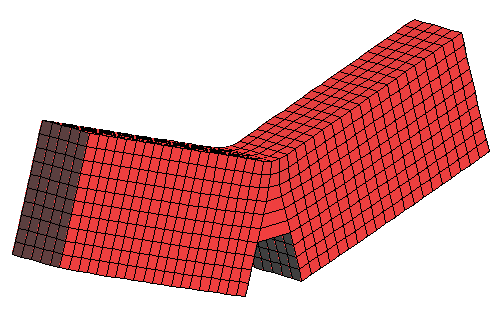
figures show the discretization and deformation of specimen at the end
of loading process. Some animations can be found here.
The load time history of reaction of prescribed outer node can
be found here.
 |
 |
| Fig. 2. Specimen discretization, generated by Jiri
Nemecek |
Fig. 3: Deformation od specimen near the end of loading process |
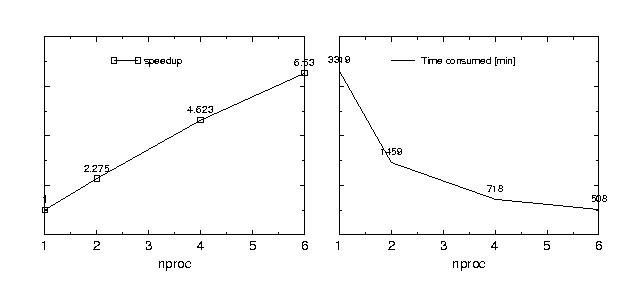
The next figure shows preliminary parallelization results. The
workstation cluster of four dual Intel Pentium II Xeon Processors, connected
using Fast Ethernet 100 network and running under Win NT Platform has been
used. Particularly, the MPI PRO library for message parsing has been used.
References:
-
Bazant, Z.P., Caner, F.C., Carol, I., Adley, M.D., and Akers, S.A.:
Microplane Model M4 for Concrete, Report 98-12/407m, submitted to U.S.
Army Corps of Engineers Waterways Experiment Station, Vicksburg, Mississippi,
1998
- B. Patzák, D. Rypl, and Z. Bittnar.: Explicit parallel dynamics with nonlocal constitutive
models. In B.H.V. Topping and B. Kumar, editors, Developments in Analysis and Design using
Finite Elements Methods. Civil-Comp Press, 1999. ISBN 0 9487 4961 X.
- Patzák, B., N\v{e}me\v{c}ek, J., Rypl, D., and Bittnar, Z.: Computational Aspects of Microplane Models and a Proposed Parallel Algorithm, in Bittnar, Z. and Topping, B.H.V., editors, Computational Concrete Structures Technology, Civil-Comp press, 2000.