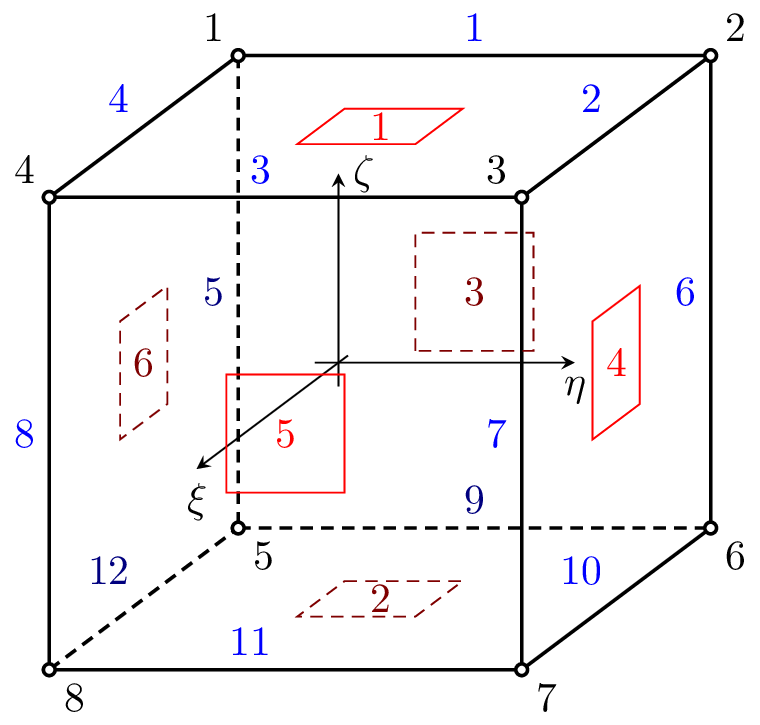
Figure 29: Brick1ht element. Node numbers are in black, side numbers are in blue, and surface numbers are
in red.
Represents isoparametric four-node tetrahedral element. Each node has 1 degree of freedom. The same numbering convection is adopted as in mechanics, see Fig. 18. The element features are summarized in Table 59.
| Keyword | Tetrah1ht |
| Description | Isoparametric, four-node tetrahedral element with linear approximation for heat transfer problems |
| Specific parameters | [NIP #(in)] |
| Parameters | NIP: allows to change the default number of integration point used. |
| Unknowns | Single dof (T_f - temperature) is required in each node. |
| Approximation | Linear approximation of temperature. |
| Integration | Integration using gauss integration formula in 1 (the default), or 4 integration points. The default number of integration point used can be overloaded using NIP parameter. |
| Loads | Body loads are supported. Boundary loads are supported and computed using numerical integration. The side and surface numbering is shown in Fig. 18. |
| Features | - |
| CS properties | - |
| Status |
|
| Tests/Examples | tests/tm/tmpatch40.in, tests/tm/tmpatch41.in, tests/tm/tmpatch42.in |
Represents isoparametric eight-node brick/hexahedron finite element for heat transfer problems. Each node has 1 degree of freedom. The element features are summarized in Table 60.
| Keyword | Brick1ht |
| Description | Isoparametric, hexahedral 3D element with linear approximation for heat transfer problems |
| Specific parameters | [NIP #(in)] |
| Parameters | NIP: allows to change the default number of integration point used. |
| Unknowns | Single dof (T_f - temperature) is required in each node. |
| Approximation | Linear approximation of temperature. |
| Integration | Integration using gauss integration formula in 8 (the default), or 27 integration points. The default number of integration point used can be overloaded using NIP parameter. |
| Loads | Body loads are supported. Boundary loads are supported and computed using numerical integration. The side and surface numbering is shown in fig. (29)). |
| Features | - |
| CS properties | - |
| Status |
|
| Tests/Examples | tests/tm/tmpatch31.in, tests/tm/tmpatch32.in, tests/tm/tmpatch34.in, tests/tm/tmpatch38.in |
Represents isoparametric eight-node quadrilateral finite element for heat and mass (one constituent) transfer problems. Two dofs (T_f - temperature and C_1 - concentration) are required in each node. Linear approximation of temperature and mass concentration. Other features are similar to Brick1 element, see section 3.4.2.
Implementation of quadratic 3d 20-node finite element. Each node has 1 degree of freedom. See section 2.8.3 for node numbering order and order of faces. The element features are summarized in Table 61.
| Keyword | QBrick1ht |
| Description | Isoparametric, hexahedral 3D element with quadratic approximation for heat transfer problems |
| Specific parameters | [NIP #(in)] |
| Parameters | NIP: allows to change the default number of integration point used, possible values are 8, 27 (default) and 64. |
| Unknowns | Single dof (T_f - temperature) is required in each node. |
| Approximation | Quadratic approximation of temperature and geometry.. |
| Integration | Integration using gauss integration formula in 8, 27 (default), or 64 integration points. The default number of integration point used can be overloaded using NIP parameter. |
| Loads | - |
| Features | - |
| CS properties | - |
| Status |
|
| Tests/Examples | tests/tm/qbrick_01.in, tests/tm/qbrick_02.in, tests/tm/qbrick_03.in |
The same element as QBrick1ht for mass transfer problems, see 3.4.4. Linear approximation of mass concentration.
The same element as QBrick1ht for heat and mass (one constituent) transfer problems. Two dofs (T_f - temperature and C_1 - concentration) are required in each node. Linear approximation of temperature and mass concentration. Other features are similar to QBrick1ht element, see section 3.4.4.