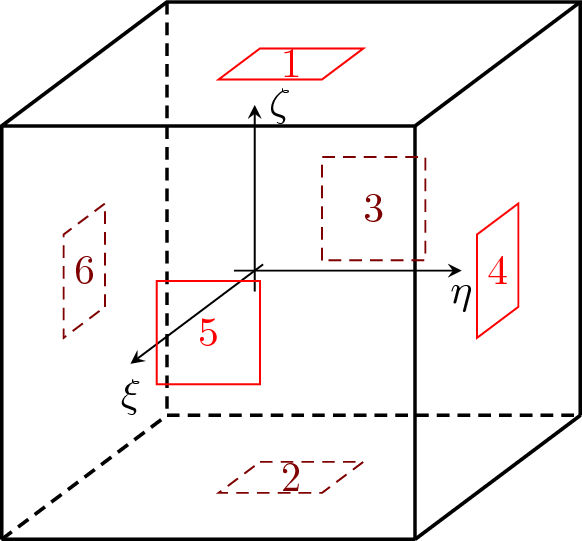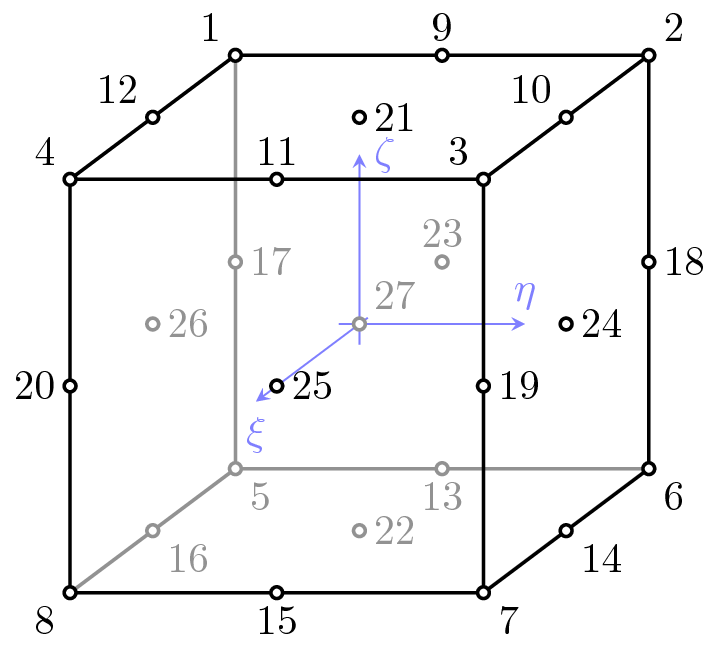
Figure 27: Tr1ht element - node and side numbering.
Implements the linear triangular finite element for heat transfer problems. Each node has 1 degree of freedom. The cross section thickness property is requested form cross section model. The node numbering is anti-clockwise. The element features are summarized in Table 57.
| Keyword | Tr1ht |
| Description | triangular finite element with linear approximation for heat transfer problems |
| Specific parameters | - |
| Unknowns | Single dof (T_f - temperature) is required in each node. |
| Approximation | Linear approximation of temperature. |
| Integration | Integration using one point gauss integration formula. |
| Loads | Body loads are supported. Boundary loads are supported and are computed using numerical integration. The side numbering is following. Each i-th element side begins in i-th element node and ends on next element node (i+1-th node or 1-st node, in the case of side number 3). The local positive edge x-axis coincides with side direction, the positive local edge y-axis is rotated 90 degrees anti-clockwise (see fig. (27)). |
| Features | - |
| CS properties | - |
| Status |
|
| Tests/Examples | tests/tm/tmpatch43-1.in, tests/tm/tmpatch43-2.in, tests/tm/tmpatch43-3.in, tests/tm/tmpatch45-1.in |
Isoparametric triangular finite element with linear approximation of moisture. Other features are the same as for Tr1ht in Section 3.2.1.
Isoparametric triangular finite element with linear approximations of temperature and moisture. Other features are the same as for Tr1ht in Section 3.2.1.
Tests/Examples: tests/tm/HeMoKunzel_1.in
Represents isoparametric four-node quadrilateral finite element for heat transfer problems. Each node has 1 degree of freedom. Problem should be defined in x,y plane. The cross section thickness property is requested form cross section model. The nodes should be numbered anti-clockwise (positive rotation around z-axis). The element features are summarized in Table 58.
| Keyword | Quad1ht |
| Description | Isoparametric four-node quadrilateral linear interpolation element for heat transfer problems |
| Specific parameters | [NIP #(in)] |
| Parameters | NIP: allows to change the default number of integration point used. |
| Unknowns | Single dof (T_f - temperature) is required in each node. |
| Approximation | Linear approximation of temperature. |
| Integration | Integration using gauss integration formula in 4 (the default), 9, or 16 integration points. The default number of integration point used can be overloaded using NIP parameter. |
| Loads | Body loads are supported. Boundary loads are supported and computed using numerical integration. The side numbering is following. Each i-th element side begins in i-th element node and ends on next element node (i+1-th node or 1-st node, in the case of side number 4). The local positive edge x-axis coincides with side direction, the positive local edge y-axis is rotated 90 degrees anti-clockwise (see fig. (28)). |
| Features | - |
| CS properties | - |
| Status |
|
| Tests/Examples | tests/tm/tmpatch01.in, tests/tm/tmpatch02.in, tests/tm/tmpatch03.in, tests/tm/tmpatch04.in |
Isoparametric four-node quadrilateral finite element. Other features are the same as for Quad1ht in Section 3.2.4.
Tests/Examples: tests/tm/nlisomoisture01.in, tests/tm/nlisomoisture02.in
Represents isoparametric four-node quadrilateral finite element for heat and mass (one constituent) transport problems. Two dofs (T_f - temperature and C_1 - concentration) are required in each node. Linear approximation of temperature and mass concentration. Other features are similar to Quad1 element, see section 3.2.4.
Represents isoparametric quadratic eight-node quadrilateral finite element for heat transfer problems. Each node has 1 degree of freedom. Problem should be defined in x,y plane. The cross section thickness property is requested form the cross section model. The nodes should be numbered anti-clockwise (positive rotation around z-axis), see fig. 10. The element has the same features as in Table 58.
Tests/Examples: tests/tm/qquad01.in
Element for mass transport problems, see the parent element in sec. 3.2.7.
Element for heat and mass transport problems, see the parent element in sec. 3.2.7.